
Pallet Rack Beam Roll Forming Machine
Rack beam roll forming line, from steel coil to welded structural beam.
Material
CR / HR / Galvanized steel / High-strength steel
Material thickness
According to beam drawing
Beam width / height
Customized
Forming speed
Up to 15 m/min
Welding / cutting
HF / laser / flying saw
Control
PLC + HMI, semi-automatic or fully automatic
Pay attention: guards and safety barriers are removed for photo and video shooting only. All safety devices must be installed and in operation during machine use.
Overview
X Machinery designs and manufactures pallet rack beam roll forming machines for the high-efficiency production of horizontal load-bearing beams used in pallet racking, warehouse storage systems and industrial shelving.
Our rack beam production solutions can be engineered for different beam structures, including one-piece beams, two-piece box beams / double-C box beams and P beams / step beams.
Each production line is developed according to the customer’s beam profile, steel thickness, beam size, required capacity, welding method and automation requirements.
From coil feeding and roll forming to seam welding, cutting, connector welding and automatic handling, X Machinery provides complete rack beam production lines designed for stable batch manufacturing.
Request information for Pallet rack beam roll forming machine
For any information or request, contact X Machinery.
Whether you manufacture one-piece rack beams, Double-C box beams or P/step beams, X Machinery can develop the production line around your actual products and production targets.
Send us your rack beam drawings, material specifications and required capacity.
Our engineering team will evaluate the forming, welding, cutting and automation requirements and recommend a suitable pallet rack beam roll forming machine and complete production line solution.
More info
High-precision production of pallet rack beams
Rack beams are the primary horizontal load-bearing components connecting two upright frames.
Their dimensional accuracy directly affects rack assembly, connector engagement and the overall consistency of the finished storage system.
For high-volume rack manufacturing, the production process must maintain consistent control of:
- Beam height and width
- Cross-section geometry
- Profile straightness
- Seam position
- Welding quality
- Cut length
- End connector position
- Surface quality
- Batch-to-batch repeatability
Our rack beam roll forming machines are engineered around the actual finished beam rather than a fixed standard machine.
The forming sequence, roller design, welding system, straightening unit and cutting method are selected according to the customer’s beam geometry and production requirements.
Beam types we can produce
One-piece beam roll forming machine
A one-piece beam is formed from a single steel strip.
During roll forming, the strip is progressively shaped into a closed or nearly closed beam section, with the edges brought together at the final forming stages. The seam can then be continuously welded according to the beam design.
Compared with a beam assembled from two separate profiles, the one-piece design can simplify the production flow and reduce intermediate material handling.
A typical one-piece beam production line can include:
Decoiler → Leveling → Roll Forming → Seam Closing → Online Welding → Straightening → Flying Cutting / Saw Cutting → Discharge
Depending on the required beam structure, the production line can be equipped with:
- High-frequency welding
- Laser welding
- Other suitable continuous welding systems
- Servo flying cutting
- Flying saw cutting
- Automatic discharge
- Automatic stacking and bundling
The forming tooling is designed according to the customer’s beam height, width, step geometry and seam configuration.
Advantages of one-piece beam production
- Continuous production from a single steel coil
- Reduced intermediate handling
- Consistent profile geometry
- Stable seam position
- Suitable for automated production
- Flexible beam dimensions based on customized tooling
- Easier integration with downstream automation
Two-piece box beam roll forming machine
A two-piece box beam, also known as a Double-C Box Beam, is produced by combining two cold-formed profiles into a closed beam section.
This type of beam is widely used in heavy-duty pallet racking because the closed cross-section provides good structural rigidity and torsional resistance.
Depending on the beam design, the two profiles can be formed separately and subsequently assembled, interlocked and welded.
X Machinery can develop the forming and joining solution according to the customer’s specific box beam structure.
Typical production requirements include:
- Accurate matching between the two profiles
- Stable profile width and height
- Controlled opening dimensions
- Consistent interlocking or overlapping position
- Reliable longitudinal welding
- Accurate finished beam length
A complete production solution can integrate:
Coil Feeding → Roll Forming → Profile Matching / Closing → Welding → Straightening → Cutting → Finished Beam Handling
For manufacturers producing multiple beam sizes, adjustable tooling or different forming configurations can be evaluated according to the relationship between the profiles.
Advantages of double-C box beams
- Closed section with high structural stability
- Suitable for medium- and heavy-duty pallet racking
- Good resistance to twisting
- Multiple beam heights and widths can be customized
- Compatible with different rack beam connectors
- Suitable for automated welding and downstream handling
P beam / step beam roll forming machine
The P Beam, commonly referred to as a Step Beam, is another widely used horizontal beam profile in pallet racking and shelving systems.
Its characteristic stepped section provides a supporting ledge that can accommodate accessories such as:
- Steel decking
- Wire mesh decking
- Timber boards
- Shelf panels
- Pallet supports
The P-shaped or stepped geometry requires accurate roll forming to maintain the position and dimensions of the supporting step.
A typical P beam roll forming machine can include:
Decoiler → Leveling → Roll Forming → Online Welding → Straightening → Cutting → Discharge
Depending on the beam design, seam welding can be integrated directly into the production line.
For different P beam sizes, the machine can also be engineered with adjustable forming structures or customized tooling-change solutions.
Key requirements for P beam production
Particular attention is given to:
- Step height
- Step width
- Beam height
- Beam face dimensions
- Closed-section geometry
- Welding seam stability
- Profile straightness
- Finished length accuracy
Stable dimensions are particularly important because the step section must work correctly with decking and other rack accessories.
Complete rack beam production line
A rack beam factory may require more than the roll forming machine itself.
According to the required automation level, X Machinery can integrate the entire production process.
A typical automated line can include:
Automatic Coil Loading → Decoiling → Leveling → Roll Forming → Online Welding → Straightening → Flying Cutting → Automatic Unloading → Connector Welding → Stacking → Bundling
The actual production sequence depends on the beam profile and manufacturing process.
Decoiling and material feeding
The decoiling system continuously supplies steel strip to the production line.
Depending on coil weight and production requirements, the line can be configured with:
- Manual loading decoiler
- Hydraulic decoiler
- Hydraulic loading car
- Automatic coil loading system
A suitable feeding and tension-control configuration helps maintain stable strip entry into the roll forming machine.
Precision roll forming
The roll forming section progressively forms flat steel strip into the required beam profile through multiple roller stations.
The roller sequence is designed according to:
- Beam geometry
- Material thickness
- Steel grade
- Yield strength
- Required production speed
- Welding seam position
The objective is not simply to achieve the final shape, but to maintain stable profile dimensions throughout continuous production.
Online welding system
Many rack beam profiles require longitudinal seam welding after the section is closed.
Depending on the product design and production requirements, different welding technologies can be evaluated. Available solutions may include:
- High-frequency welding
- Laser welding
- Continuous seam welding solutions
The welding section can be synchronized with the roll forming speed for continuous production.
The appropriate welding process is selected according to material thickness, beam structure, required speed and finished-product quality requirements.
Straightening system
Closed beam profiles can develop bow, twist or dimensional deviation as a result of material properties, forming stress and welding heat.
A dedicated straightening system can therefore be installed after forming and welding to correct the finished beam before cutting.
Flying cutting or saw cutting
Different rack beam profiles require different cutting methods.
Depending on beam geometry and production speed, available solutions include:
- Servo flying saw cutting
- Flying cutting system
- Hydraulic cutting
- Customized profile cutting
For closed box beams and P beams, the cutting method is selected according to cross-section geometry, wall thickness and required cut quality.
Beam connector welding
The rack beam must ultimately connect accurately with the upright.
Beam end connectors, sometimes referred to as beam brackets or beam connector plates, can be welded to both ends after the beam is formed and cut.
For higher-volume production, X Machinery can develop or integrate automatic connector positioning and welding solutions.
Critical factors include:
- Connector position
- Left/right symmetry
- Welding angle
- Beam length
- Connector-to-beam alignment
- Repeatability between production batches
Accurate connector positioning helps ensure smooth installation of the finished beam into the upright frame.
Custom solutions for different rack beam sizes
Rack manufacturers often produce a family of beams rather than one single profile. Typical variations include:
- Different beam heights
- Different beam widths
- Different steel thicknesses
- Different step dimensions
- Different beam lengths
- Different connector systems
- Different load classes
X Machinery evaluates the relationship between these products before determining the most suitable machine structure. Depending on the beam family, we can evaluate:
Adjustable roll forming system
Selected roller positions can be automatically or manually adjusted to produce multiple related beam sizes.
Tooling change system
Different roller tooling sets can be used when profile geometries vary significantly.
Interchangeable forming modules
For manufacturers with a broad product portfolio, modular forming solutions can be evaluated to reduce changeover time.
The appropriate solution is determined according to production volume, number of SKUs and the dimensional relationship between the different beam profiles.
Materials
The pallet rack beam production line can be designed for materials such as:
- Cold-rolled steel
- Hot-rolled steel
- Galvanized steel
- High-strength structural steel
Material thickness and mechanical properties must be confirmed before machine design.
Higher yield-strength steel requires additional consideration of forming force, spring-back, roll design, shaft loading and cutting requirements.
Typical applications
- Heavy-duty pallet racking: horizontal load-bearing beams for industrial warehouses, logistics centers and distribution facilities.
- Selective pallet racking: one-piece beams, box beams and step beams used in conventional selective pallet rack systems.
- Mezzanine storage systems: structural beams and supporting profiles used in multi-level warehouse and mezzanine structures.
- Industrial shelving: P beams and step beams designed to support steel panels, timber boards or wire decking.
- Automated storage systems: consistent rack beam production for high-volume and automated warehouse racking projects.
Lines delivered and running
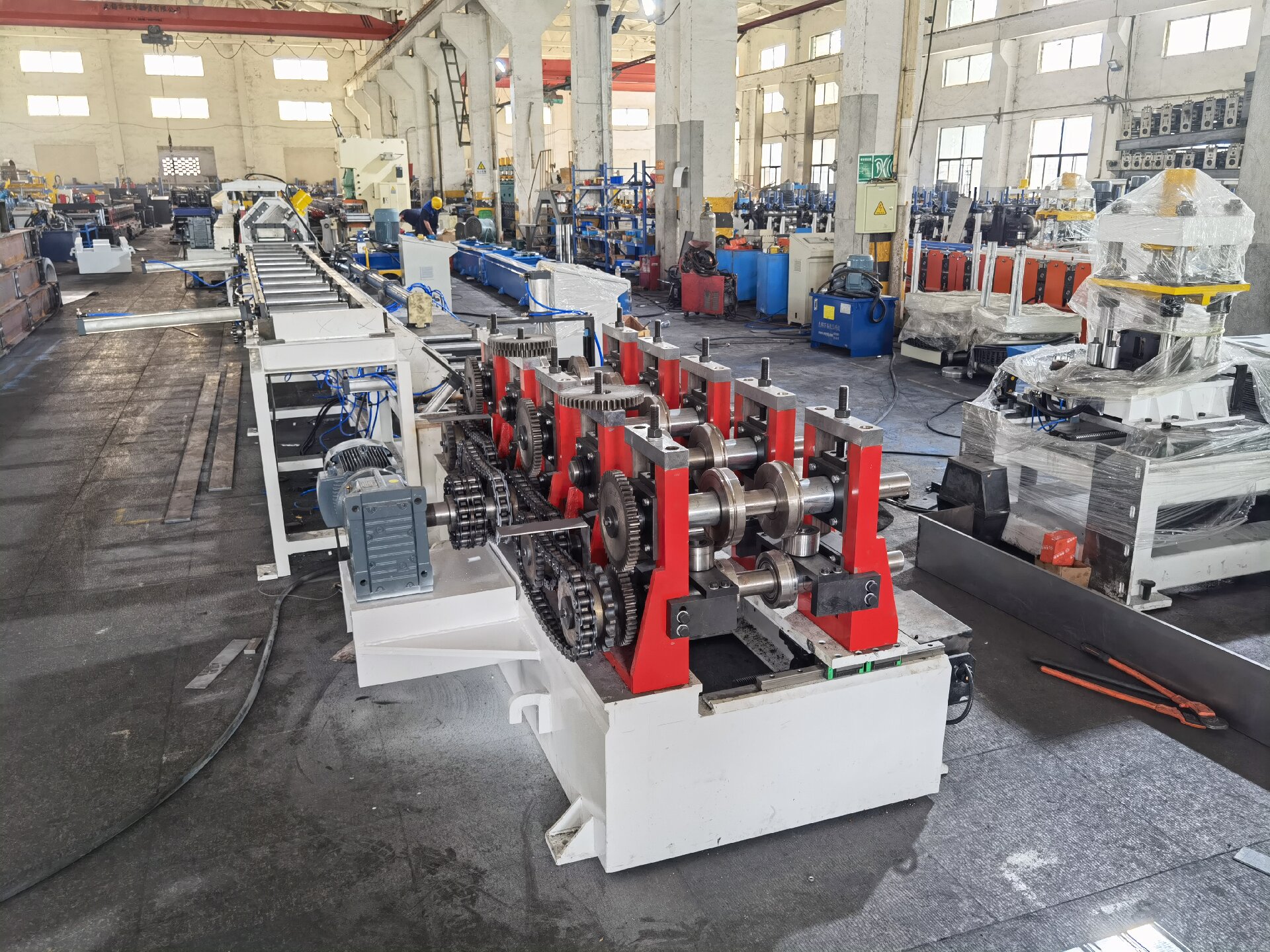
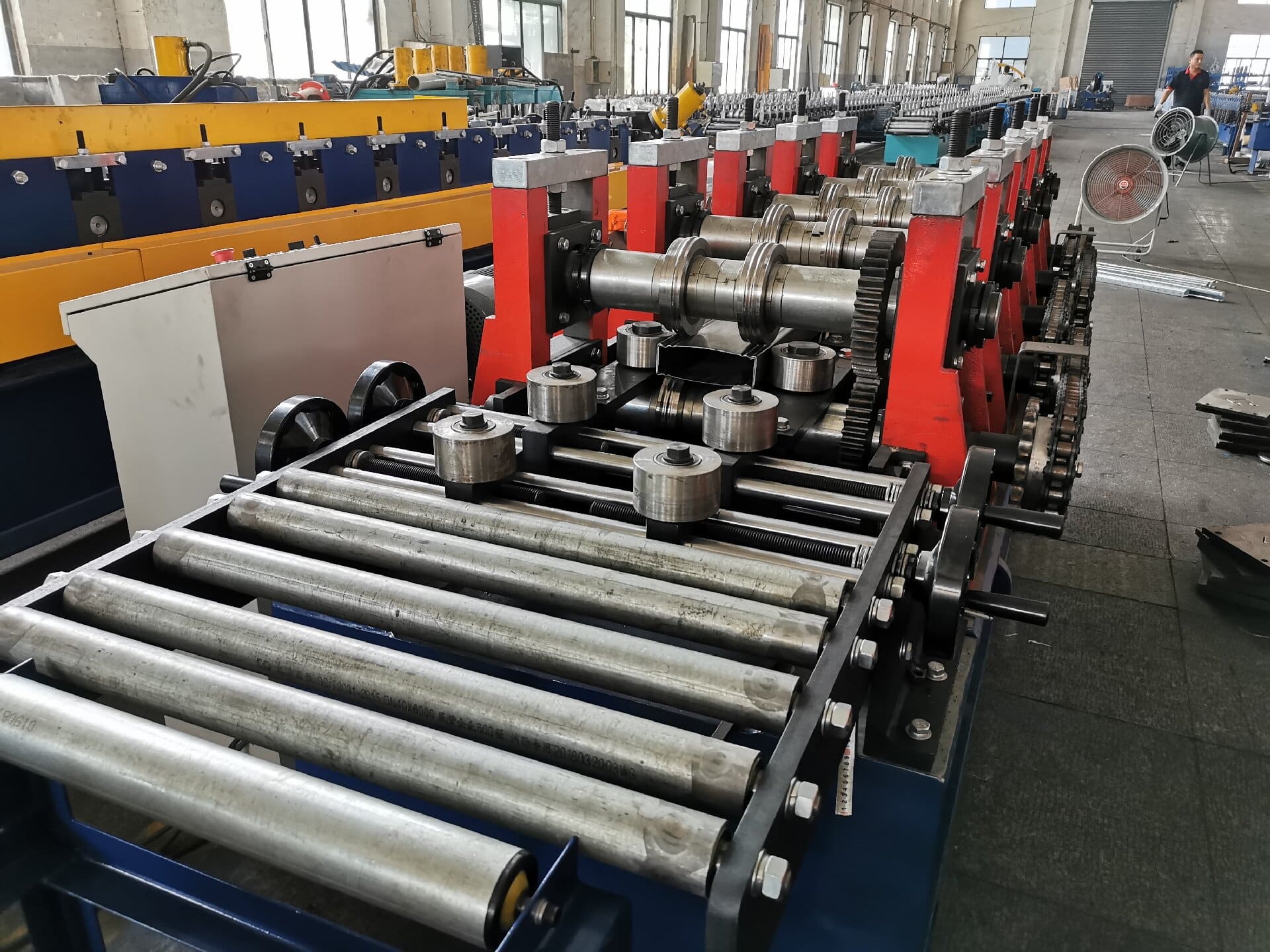
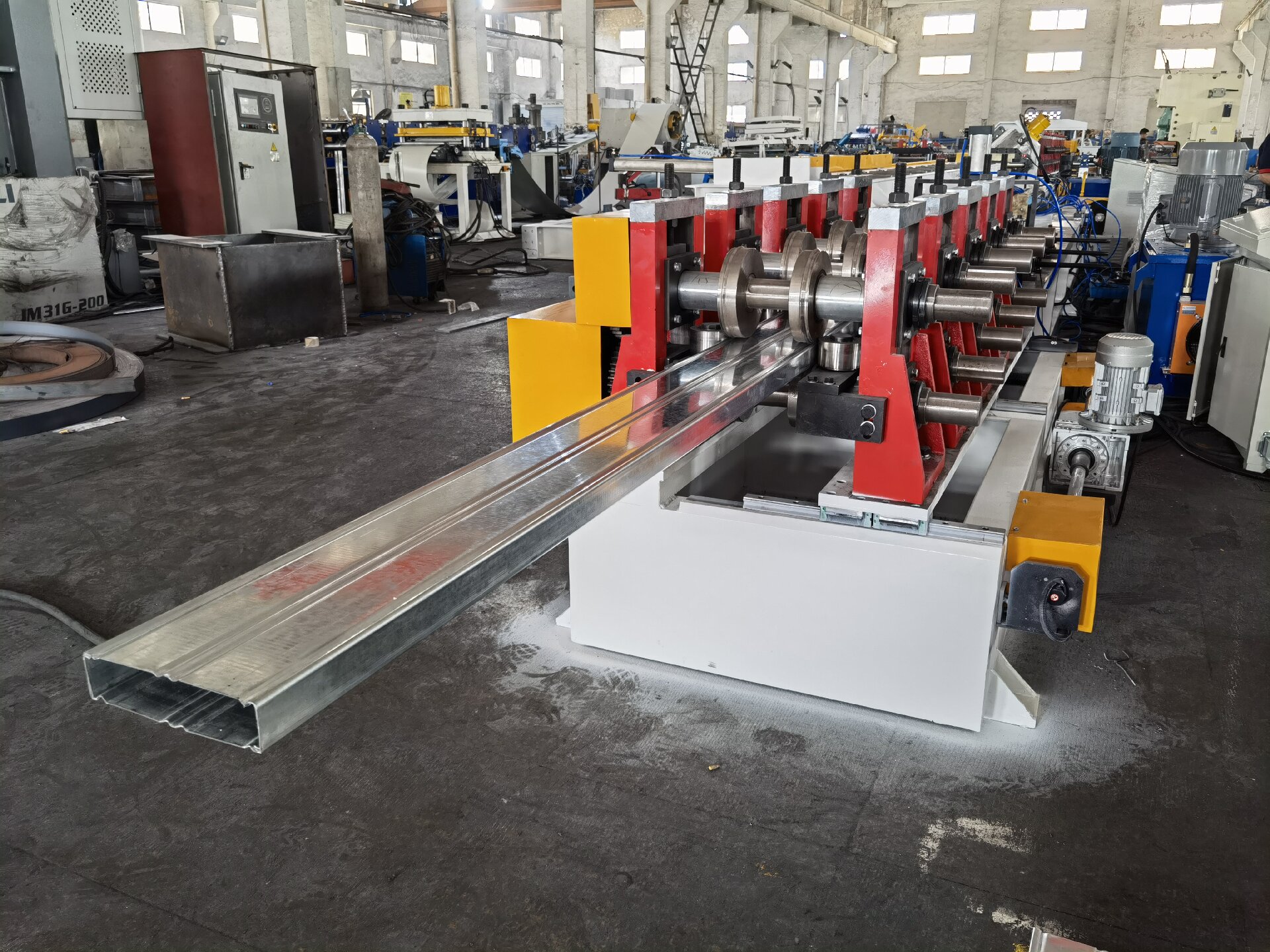
Photos from customer projects. Replace the images with your own and update the captions.
Available equipment and automation options
According to the required production process, the rack beam line can be configured with:
- Coil handling and leveling: automatic coil loading system, hydraulic loading car, hydraulic decoiler, leveling system, strip guiding system
- Forming: roll forming machine, adjustable-width forming system, interchangeable tooling, automatic seam closing system
- Welding: high-frequency welding system, laser welding system, weld seam monitoring
- Straightening and cutting: straightening system, servo flying cutting, flying saw cutting
- Connector system: automatic unloading, beam connector positioning system, automatic connector welding
- Downstream automation: automatic stacking, automatic bundling, automatic packaging
- Control: PLC and HMI control, production data interface
The final equipment configuration is determined according to the customer’s actual beam drawing and required manufacturing process.
Technical specifications
Values marked as customized are confirmed from your beam drawing and production target.
| Machine | Pallet rack beam roll forming machine | Finished products | One-piece beam / box beam / P beam / step beam |
|---|---|---|---|
| Material | CR / HR / galvanized steel / high-strength steel | Material thickness | According to beam drawing |
| Material yield strength | According to customer requirement | Beam width | Customized |
| Beam height | Customized | Beam length | Customized |
| Forming speed | Up to 15 m/min | Welding system | HF / laser / customized |
| Cutting system | Flying saw / servo flying cut / customized | Changeover | Fixed / adjustable / tooling change |
| Control | PLC + HMI | Automation level | Semi-automatic / fully automatic |
| Power supply | Customized for destination country |
What we need before designing your rack beam machine
A professional rack beam production line should be developed according to the customer’s actual product rather than selected only from a standard machine specification.
Before engineering the line, please provide:
- Beam cross-section drawing
- Beam dimensions
- Material grade
- Material yield strength
- Steel thickness range
- Required beam lengths
- Number of beam sizes
- Beam connector drawing
- Required production capacity
- Preferred welding process, if specified
- Required automation level
- Finished product samples, if available
Our engineering team will evaluate the complete manufacturing process before proposing the machine configuration.
Why rack manufacturers choose X Machinery
- Custom engineering: the machine is designed around your beam profile, material and production requirements rather than forcing your product into a fixed machine configuration.
- Complete production process: we can integrate roll forming, welding, straightening, cutting and downstream automation into one coordinated rack beam production solution.
- Multi-profile capability: for manufacturers producing multiple beam sizes, adjustable or interchangeable forming solutions can be developed according to the product family.
- Automation integration: from coil handling to finished beam stacking, the production line can be configured for different levels of automation.
- Focus on production stability: machine structure, roll tooling, drive system and process layout are selected with continuous batch manufacturing in mind.
FAQ
What types of pallet rack beams can the machine produce?
Our rack beam roll forming machines can be designed for one-piece beams, box beams, Double-C beams, P beams, step beams and other customized racking beam profiles.
What is the difference between a one-piece beam and a two-piece box beam?
A one-piece beam is roll formed from a single steel strip and normally closed along a longitudinal seam. A two-piece box beam is produced by combining two separately formed profiles, commonly two C-shaped sections, into a closed box section. The appropriate production process depends on the customer’s beam design and structural requirements.
Is a P beam the same as a step beam?
In many pallet racking applications, P beam is used to describe a stepped beam profile. The step provides a supporting ledge for decking, panels or other rack accessories. Terminology varies between markets, so we design the machine according to the actual profile drawing rather than the profile name alone.
Can one machine produce multiple beam sizes?
Yes, depending on the relationship between the different profiles. If several beam sizes share the same basic geometry, an adjustable forming system may be possible. If the profile geometry changes significantly, interchangeable tooling or separate forming modules may be more appropriate.
Can welding be integrated into the roll forming line?
Yes. For closed rack beams, an online welding system can be integrated after the section is formed and closed. The suitable welding method depends on beam structure, steel thickness, line speed and required weld quality.
What information is required for a quotation?
Please send us your beam profile drawing, material grade, steel thickness, beam lengths, required production speed and annual or monthly production capacity.
Request information for Pallet rack beam roll forming machine
For any information or request, contact X Machinery.
Whether you manufacture one-piece rack beams, Double-C box beams or P/step beams, X Machinery can develop the production line around your actual products and production targets.
Send us your rack beam drawings, material specifications and required capacity.
Our engineering team will evaluate the forming, welding, cutting and automation requirements and recommend a suitable pallet rack beam roll forming machine and complete production line solution.
Request information
For any information or request, contact X Machinery.
Send us your rack beam drawings, material specifications and required capacity, and our engineering team will recommend a suitable production line configuration.