
Shelf Panel Roll Forming Machine
Shelf panel roll forming line, from steel coil to stacked finished panel.
Material
CR / Galvanized / Pre-painted steel
Material thickness
According to shelf drawing
Panel width / depth
Customized
Punching
Hydraulic / Mechanical / Servo
Width changeover
Fixed / Manual / Motorized / Automatic
Control
PLC + HMI, semi or fully automatic
Pay attention: guards and safety barriers are removed for photo and video shooting only. All safety devices must be installed and in operation during machine use.
Overview
X Machinery designs and manufactures shelf panel roll forming machines for producing steel shelf panels used in pallet racking, warehouse shelving, industrial storage racks and metal shelving systems.
Unlike simple profile forming, shelf panel production requires coordinated control of panel width, depth, edge geometry, reinforcing ribs, punching positions, folding accuracy and finished-panel flatness.
Our metal shelf production lines are engineered around the customer’s actual shelf drawings, required load capacity, material thickness, panel dimensions and production volume.
Depending on the shelf design, a complete line can integrate decoiling, leveling, punching, embossing, roll forming, cutting, edge folding, reinforcement production, welding or clinching, automatic stacking and packaging.
Request information for Shelf panel roll forming machine
For any information or request, contact X Machinery. Send us your shelf panel and reinforcement drawings, material specifications, size range and required production capacity, and our engineering team will evaluate the complete manufacturing process.
More info
Design focus for shelf panel production
Steel shelf panels are widely used as horizontal storage surfaces in industrial shelving and warehouse racking systems. Although their appearance may seem relatively simple, accurate and repeatable production is important because dimensional deviations can affect installation, shelf alignment and compatibility with the rack structure.
During machine design, particular attention is given to:
- Panel width and depth
- Edge dimensions
- Side-folding geometry
- Reinforcing rib position
- Embossing pattern
- Hole and slot position
- Panel flatness
- Diagonal accuracy
- Cut length
- Reinforcement positioning
- Finished load-bearing requirements
X Machinery develops the forming sequence and machine configuration according to the actual shelf panel rather than applying one standard solution to every product.
Complete shelf panel production line
A typical shelf panel roll forming production line can be configured as:
Hydraulic Decoiler → Leveling → Servo Feeding → Punching / Embossing → Roll Forming → Cutting → Edge Folding → Reinforcement Assembly → Welding / Clinching → Automatic Stacking
The actual process sequence depends on the customer’s shelf design.
- For simpler shelf panels, punching or reinforcement assembly may not be required.
- For higher-capacity industrial shelves, additional reinforcing profiles can be manufactured separately and automatically or manually assembled underneath the shelf panel.
Line technology
Each module below is selected and configured according to your product range rather than sold as a fixed catalogue specification.
Precision punching and notching
Shelf panels may require holes, slots or notches for assembly, connection or accessory installation. The punching system can be designed according to the customer’s actual hole pattern and product dimensions. Depending on production requirements, the line can use:
- Hydraulic punching
- Mechanical press punching
- Servo-controlled punching
- Customized multi-station dies
Servo feeding helps maintain the relationship between punching positions, panel dimensions and the following forming process. For products with several shelf sizes or different hole arrangements, programmable punching solutions can be evaluated.
Embossing and reinforcing rib forming
Shelf stiffness is influenced not only by steel thickness but also by panel geometry. Embossed patterns and longitudinal reinforcing ribs can increase panel rigidity without simply increasing material thickness. According to the shelf design, the machine can incorporate embossing or rib-forming stations before or during roll forming. Typical designs may include:
- Longitudinal reinforcing ribs
- Shallow structural embossing
- Anti-slip surface patterns
- Customized reinforcement geometries
The embossing structure is developed according to the customer’s shelf drawing and load requirements.
Precision roll forming
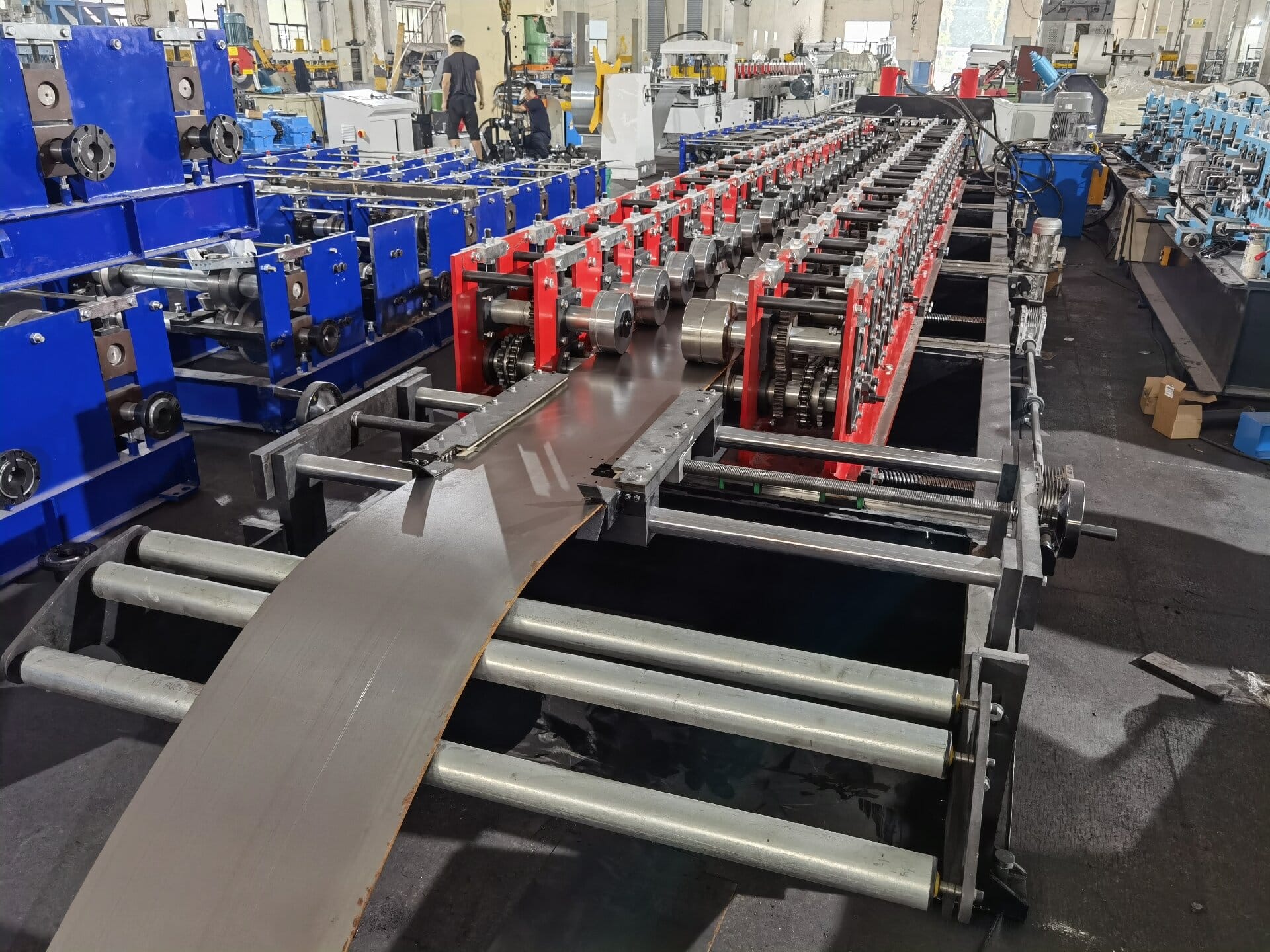
After feeding and punching, the steel strip enters the roll forming section. Multiple forming stations progressively create the required shelf geometry while controlling material deformation. For shelf panels, the forming process can include:
- Side edge forming
- Reinforcing rib forming
- Return edge forming
- Locking geometry
- Structural bends
- Side-wall profiling
The roller tooling is CNC machined according to the customer’s profile. The number of forming stations, roller diameter, shaft configuration and drive system are selected according to material thickness, panel geometry and required production speed.
Automatic width changeover
Rack and shelving manufacturers often need to produce multiple shelf sizes. Instead of building one machine for every panel width, X Machinery can evaluate adjustable-width shelf panel roll forming systems for related product families.
When the shelf profiles share the same basic geometry, selected forming stands can move laterally through motorized or servo-controlled adjustment. The operator enters the required product size through the HMI, and the machine adjusts the corresponding forming position according to the programmed recipe.
This can significantly reduce manual adjustment requirements when producing multiple shelf dimensions. The actual achievable size range depends on the relationship between the customer’s different shelf profiles.
Cutting and edge folding
Shelf panels usually require accurate front and rear edges in addition to longitudinal roll forming. Depending on the product structure, cutting and folding can be completed through an integrated downstream system. Available solutions can include:
- Servo shearing
- Hydraulic cutting
- Automatic front-edge folding
- Automatic rear-edge folding
- Customized end-forming systems
Accurate synchronization between feeding, cutting and folding helps maintain consistent shelf length and diagonal dimensions.
Shelf reinforcement profile production
Heavy-duty shelf panels often require reinforcing profiles underneath the panel to increase load capacity. X Machinery can provide a separate shelf reinforcement roll forming machine or integrate reinforcement production into a complete shelf manufacturing system. Typical reinforcement profiles can include:
- C-shaped reinforcement profiles
- U-shaped reinforcement profiles
- Hat-shaped reinforcement profiles
- Customized structural channels
The reinforcement profile is designed according to the shelf structure and required loading performance. For manufacturers producing large quantities of shelves, reinforcement production can be synchronized with the main shelf panel line.
Reinforcement assembly and welding
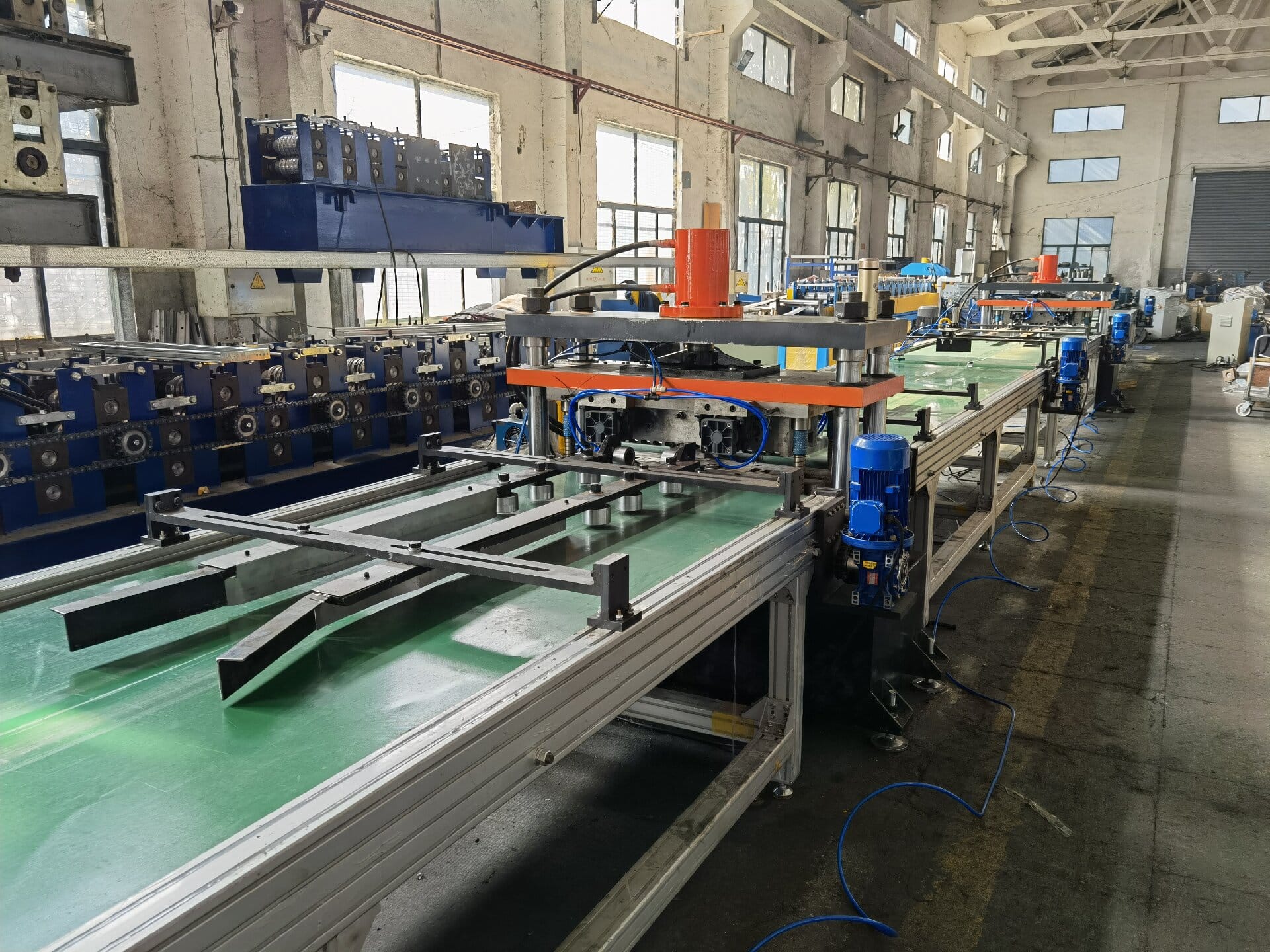
After the shelf panel and reinforcement profiles are produced, reinforcement sections can be positioned underneath the shelf. Depending on the product structure and required automation level, attachment methods may include:
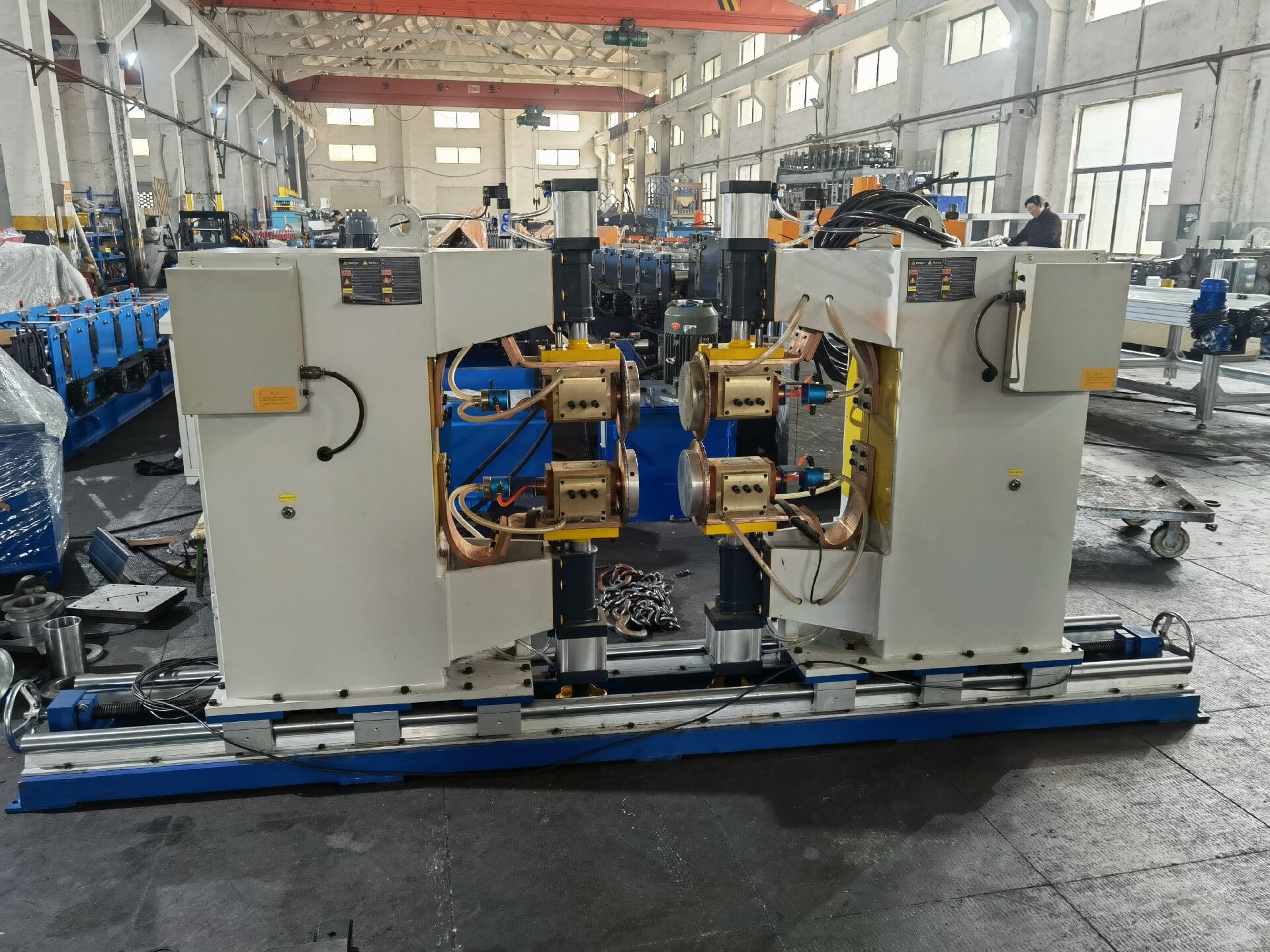
- Spot welding
- Resistance welding
- Continuous welding
- Clinching
- Rotary clinching
- Customized mechanical joining
Automatic positioning and welding systems can be integrated for high-volume production. Important process parameters include reinforcement spacing, positioning accuracy, welding consistency and panel deformation after welding. The final joining method is selected according to the customer’s shelf design and manufacturing standard.
Shelf panel flatness and dimensional control
Wide and relatively thin shelf panels are more sensitive to material stress and deformation than narrow roll-formed profiles. Improper forming, embossing, cutting or welding can result in:
- Panel bow
- Edge deformation
- Twisting
- Uneven corners
- Diagonal deviation
- Local welding distortion
For this reason, X Machinery evaluates the complete production process rather than focusing only on the main roll former. Material leveling, forming sequence, reinforcement design, cutting method and welding process are coordinated to improve finished-panel consistency.
Flexible production for multiple shelf sizes
Industrial shelving manufacturers usually produce a range of shelf dimensions. Typical variations include different:
- Shelf widths
- Shelf depths
- Steel thicknesses
- Edge heights
- Reinforcement quantities
- Reinforcement positions
- Embossing patterns
- Hole configurations
- Load ratings
When these products belong to the same profile family, an adjustable machine can be developed to reduce changeover time. For products with substantially different structures, interchangeable tooling or separate forming modules may provide a more suitable solution.
X Machinery evaluates the customer’s entire product range before recommending the machine configuration.
Materials
Shelf panel production lines can be engineered for materials such as:
- Cold-rolled steel
- Galvanized steel
- Pre-painted steel
- Carbon steel
Material thickness and mechanical properties must be confirmed before machine design. For thin, wide shelf panels, material flatness and coil quality can have a significant influence on finished-panel consistency.
Typical applications
- Pallet racking shelf panels: steel shelf panels used between pallet rack beams to create solid storage surfaces for cartons, components and loose products.
- Industrial shelving: metal shelves used in warehouses, workshops, factories, distribution centers and industrial storage facilities.
- Long-span shelving: shelf panels combined with structural beams for medium- and heavy-duty storage systems.
- Warehouse storage racks: steel shelf panels designed for logistics centers, spare-parts warehouses and general industrial storage.
- Commercial metal shelving: customized metal shelves used in retail, supermarkets and commercial storage systems when suitable for the required shelf design.
Lines delivered and running
Photos from customer projects. Replace the images with your own and update the captions.
Available production line options
According to the customer’s production requirements, the shelf panel line can integrate:
- Coil handling and leveling: automatic coil loading, hydraulic decoiler, precision leveling
- Feeding, punching and embossing: servo feeding, hydraulic punching, mechanical press punching, multi-station punching dies, embossing system
- Forming: roll forming machine, automatic-width adjustment
- Cutting and edge folding: servo cutting, hydraulic cutting, front and rear edge folding
- Reinforcement: reinforcement roll forming machine, reinforcement automatic feeding, automatic positioning
- Joining: spot welding, resistance welding, clinching system
- Automation and control: automatic unloading, automatic stacking, automatic bundling and packaging, PLC and HMI control, production recipe management
The final configuration is determined according to the shelf drawing, required production capacity and automation target.
Technical specifications
Values marked as customized are confirmed from your shelf drawing and production target.
| Machine | Shelf panel roll forming machine | Embossing | Optional |
|---|---|---|---|
| Finished product | Steel shelf panel | Width changeover | Fixed / manual / motorized / automatic |
| Application | Pallet racking / industrial shelving / storage racks | Cutting | Servo / hydraulic |
| Material | CR / galvanized steel / customized | Edge folding | Automatic / customized |
| Material thickness | According to shelf drawing | Reinforcement | Optional |
| Panel width | Customized | Reinforcement joining | Welding / clinching / customized |
| Panel depth | Customized | Control | PLC + HMI |
| Panel length | Customized | Automation | Semi-automatic / fully automatic |
| Forming speed | According to line configuration | Power supply | Customized for destination country |
| Production capacity | According to product and process | Punching | Hydraulic / mechanical / servo controlled |
Custom engineering based on your shelf panel drawing
Shelf panel production requirements vary significantly between manufacturers. Before designing the machine, our engineering team evaluates:
- Shelf panel drawing
- Panel width and depth
- Material type
- Material thickness
- Material yield strength
- Embossing or reinforcing rib design
- Punching or notching requirements
- Front and rear edge structure
- Reinforcement profile drawing
- Number and position of reinforcements
- Required load capacity
- Product size range
- Required production capacity
- Required automation level
Based on this information, we determine the forming process, punching method, changeover structure, cutting and folding system, reinforcement production method and downstream automation.
Why choose an integrated shelf panel production line?
- Higher production efficiency: integrating punching, forming, cutting and folding reduces intermediate material handling and allows continuous batch production.
- Consistent product dimensions: coordinated servo feeding and automated processing help maintain consistent panel dimensions across production batches.
- Flexible size production: adjustable forming systems can be developed for related shelf sizes, reducing the time required to change between products.
- Integrated reinforcement production: shelf reinforcement profiles, positioning and joining can be incorporated into the overall production solution.
- Reduced manual handling: automatic unloading, transfer, welding and stacking can reduce manual intervention between processes.
- Customized around your product: machine configuration is developed from the actual shelf panel and reinforcement drawings rather than from a fixed standard specification.
FAQ
What is a shelf panel roll forming machine?
A shelf panel roll forming machine is an automated production system used to manufacture steel shelf panels for pallet racking, warehouse storage racks and industrial shelving. Depending on the product design, the line can integrate decoiling, leveling, punching, embossing, roll forming, cutting, edge folding and reinforcement assembly.
Can one machine produce different shelf widths?
Yes, when the different shelf sizes share compatible profile geometry. Motorized or servo-controlled width adjustment can be designed to move selected forming stands according to the required product size. The available width range must be evaluated from the customer’s actual shelf drawings.
Can the machine produce shelves with different depths?
This depends on how the shelf profile is designed. In some product families, shelf depth is determined mainly by the adjustable distance between forming sections, allowing multiple depths to be produced on one machine. For substantially different profiles, tooling changes or different machine configurations may be required.
Can punching and embossing be integrated?
Yes. Punching, notching, reinforcing ribs and embossing can be integrated into the production process according to the shelf design.
Can reinforcement profiles be produced automatically?
Yes. A separate reinforcement roll forming machine can be integrated with the shelf panel production system. Reinforcement profiles can then be transferred for positioning and joining underneath the shelf panel.
Can reinforcement welding be automated?
Yes. Depending on the shelf design, automatic positioning and spot or resistance welding systems can be integrated into the downstream process. Clinching can also be evaluated when suitable for the customer’s product structure.
How do you determine the required production speed?
Production capacity should be evaluated according to the complete cycle rather than only the maximum roll forming speed. Punching, cutting, folding, reinforcement positioning and welding can all affect the actual number of finished shelf panels produced per minute. For this reason, we evaluate the complete production process before recommending a line speed.
What information is required for a quotation?
Please provide the shelf panel drawing, material grade, steel thickness, product dimensions, reinforcement drawing, required size range and target production capacity. Send them to info@example.com.
Request information for Shelf panel roll forming machine
For any information or request, contact X Machinery. Send us your shelf panel and reinforcement drawings, material specifications, size range and required production capacity, and our engineering team will evaluate the complete manufacturing process.
Request information
For any information or request, contact X Machinery